

The Landscape of Holocaust Memory: A Report from the Bergen-Belsen International Summer School (2019)

Updated: Mar 20
This article is part of a three-article series on the Bergen-Belsen Memorial. You may also read the accompanying historical essay and theoretical essay.

“Immediately after the handover of the Bergen-Belsen camp to the British Army and the liberation of its prisoners on 15 April 1945, Bergen-Belsen became a worldwide symbol for Nazi crimes.” — Bergen-Belsen: History of the Memorial
The liberation of Bergen-Belsen revealed to the world the scale of suffering and death that had occurred within the camp. Tens of thousands of prisoners had already died there, and thousands more perished in the weeks following liberation as a result of the conditions they had endured. Today, the cemeteries and mass graves at the site stand as central places of mourning and remembrance. Bergen-Belsen has thus become not only a historical location but also a significant site within the global culture of Holocaust memory.
In 2019, I had the opportunity to participate in the Bergen-Belsen International Summer School, an interdisciplinary programme dedicated to examining the evolving culture of Holocaust remembrance. Bringing together young scholars and researchers from different backgrounds, the programme encouraged participants to reflect critically on how sites of Nazi persecution are interpreted, memorialised, and communicated to diverse audiences today.

As Stephanie Billib and Katrin Unger explain in the programme booklet, the summer school aimed to encourage participants and speakers “to actively engage with current discourses surrounding the approach to sites of Nazi persecution, the design of memorials and the reception of these processes.” This approach was grounded in the recognition that historical sites of persecution such as Bergen-Belsen must continually respond to “shifting, changing points of reference” in the ways societies understand and engage with the past (Billib & Unger, Bergen-Belsen International Summer School Programme, 2019). The organisers also emphasised the importance of situating memorial work within what they describe as a broader “global memory culture,” acknowledging the diverse ways in which remembrance is shaped across different contexts.

Opening the Programme
The programme was opened by Maximilian Vogel, who welcomed participants to the sixth Bergen-Belsen International Summer School. Nineteen participants from different academic and national backgrounds took part in the programme. Vogel also outlined some of the key intellectual highlights of the week, including a keynote lecture by Wulf Kansteiner, Professor of History at Aarhus University.
In addition to the lectures and workshops, the programme offered opportunities to explore memorial sites beyond Bergen-Belsen itself. Participants were introduced to the developing memorial at Hannoverscher Bahnhof in Hamburg and took part in discussions related to the forthcoming 75th anniversary of the liberation of the Bergen-Belsen concentration camp. These activities were designed to provide insight into contemporary challenges facing memorial institutions and the ways in which the memory of National Socialism continues to evolve.
An important feature of the programme was the emphasis on independent exploration. Participants were encouraged to visit different parts of the memorial site individually and develop their own questions about the historical landscape and its representation.

Encountering the Site
One of the most significant components of the summer school was a guided tour of the former camp grounds led by Nils Hunold. The tour provided an overview of the history of Bergen-Belsen, which initially functioned as a prisoner-of-war camp primarily for Soviet soldiers, but also held Italian and Polish prisoners. Hunold explained the “various functions and changes of the concentration camp from the exchange camp to the reception and death camp” (Hunold, 2019).
"Until the moment of liberation [of the Bergen-Belsen Camp], almost 20,000 prisoners of war and 38,000 concentration camp prisoners had died there; another 14,000 former prisoners of the camp died over the six weeks that followed." — Bergen-Belsen: History of the Memorial
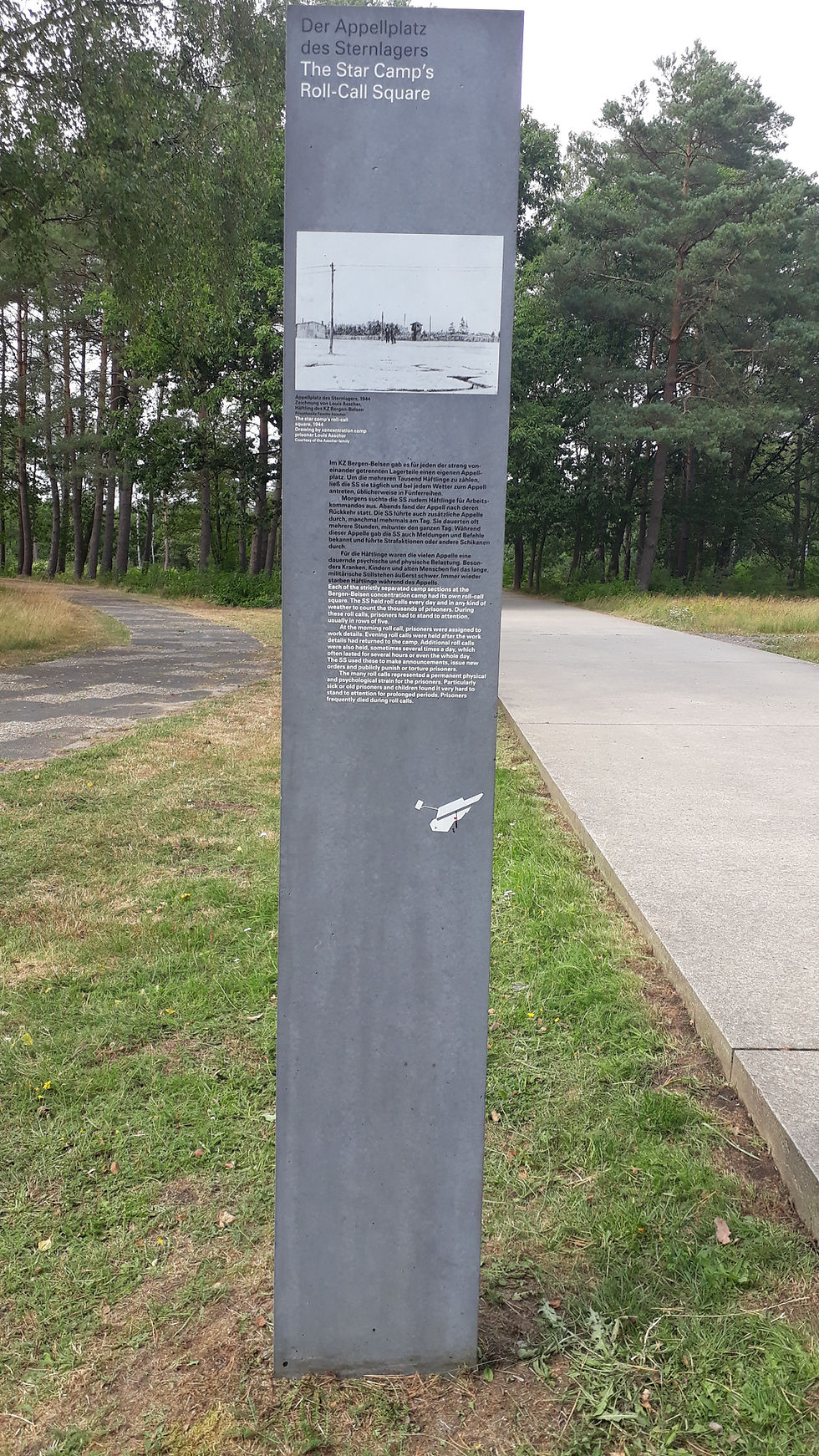
Walking through the former camp grounds made visible the physical traces that remain today. Participants encountered the locations of former barracks and visited the areas where mass graves and memorial monuments are now situated. These visits prompted discussions about the multiple layers of remembrance associated with the site and the ways in which local, national, and international cultures of memory intersect at Bergen-Belsen.

Exploring the Memorial Exhibition
Following the tour of the camp grounds, participants visited the permanent exhibition at the Bergen-Belsen Memorial. Tessa Bouwman and Maximilian Vogel introduced the exhibition and encouraged participants to explore it independently. According to the programme booklet, this approach was intended “to deepen the first impressions” formed during the tour and to allow participants to pursue their own interests and questions while engaging with the exhibition (Bouwman & Vogel, 2019).

This combination of guided interpretation and independent exploration formed an important methodological aspect of the programme, encouraging participants to reflect on the relationship between historical evidence, exhibition design, and personal interpretation.
The Military Barracks and the Aftermath of Liberation
Another significant session was led by Katja Seybold, who introduced participants to the history of the military barracks located near the camp. Today known as the Niedersachsen barracks, the site is closely connected to the history of Bergen-Belsen.
The barracks were originally part of a military training area established in the mid-1930s. From 1941 to 1943 they housed the headquarters of the prisoner-of-war camp Stalag XI C (311) Bergen-Belsen. In early April 1945, as the concentration camp became severely overcrowded, the Wehrmacht transferred part of the barracks to the SS to house more than 15,000 prisoners.
After the liberation of the camp by British forces on 15 April 1945, the barracks were used as an emergency hospital for survivors of the concentration camp. Despite these efforts, many prisoners who had endured the extreme conditions of imprisonment did not survive the aftermath of liberation. By the end of June 1945, approximately 14,000 people had died as a result of their imprisonment. Many of those who died were buried in cemeteries established by the British in the barracks area (Seybold, 2019).

In the months following the war, the barracks also became a Displaced Persons camp. While many former prisoners eventually returned to their homes, thousands of survivors remained. Around 10,000 non-Jewish Polish citizens and approximately 10,000 Jews—primarily from Poland and Hungary—lived there for a period as they began rebuilding their lives. In this sense, the barracks became not only a site of tragedy but also a place associated with new beginnings.

Research, Documentation, and Education
The programme also introduced participants to the institutional work that supports the memorial. Representatives from the Research and Documentation department—including Diana Gring, Bernd Horstmann, and Katja Seybold—explained how their work brings together archival science, documentation, library science, and historical research.

The department is responsible for collecting, preserving, and studying materials related to the various phases of Bergen-Belsen’s history. It also contributes to exhibitions and collaborates with other memorial sites, research institutions, and members of the public both in Germany and internationally (Gring, Horstmann & Seybold, 2019).
Educational work at the memorial was discussed by Daniel Tonn from the Education and Encounters department. A key goal of the educational programmes is to encourage critical engagement with the history of the Bergen-Belsen prisoner-of-war camp, the concentration camp, and the later Displaced Persons camp. According to the programme description, these educational activities aim to motivate visitors to explore the history of National Socialism, question established narratives, and develop their own perspectives through discussion and reflection (Tonn, 2019).

Digital Strategies and Memorial Communication
Another workshop addressed the role of digital tools in memorial work. Stephanie Billib presented the memorial’s approach to digital strategies, highlighting the challenge of addressing diverse audiences while maintaining historical seriousness.
Memorial sites today are expected to provide accessible and multifaceted ways of engaging with history for visitors of different ages, educational backgrounds, and cultural contexts. At the same time, digital approaches raise questions about how to balance accessibility with the risk of reducing complex historical events to overly simplified forms of presentation (Billib, 2019).
Holocaust Memory in a Transnational Context
The keynote lecture delivered by Wulf Kansteiner explored the relationship between national memory and transnational Holocaust culture. Kansteiner argued that since the 1970s narratives about the Holocaust have circulated widely across different countries through media and cultural production.
These shared narratives have contributed to what might be described as a transnational Holocaust culture. Yet the meanings attached to these narratives are shaped by local historical contexts and perspectives. As a result, the relationship between global memory culture and national memory remains complex and dynamic (Kansteiner, 2019).
Popular Culture and Transnational Memory
Several workshops during the summer school examined the broader question of transnational memory. In one session, Maximilian Vogel explored how popular culture contributes to the remembrance of the Holocaust.
According to Vogel, films, television, literature, and other forms of cultural production have played an increasingly significant role in shaping public perceptions of the Holocaust over the past several decades. These representations can reach wide audiences and contribute to global awareness of historical events. At the same time, they raise ethical questions about how traumatic histories are represented within the culture industry (Vogel, 2019).
Concluding Discussions
The summer school concluded with a discussion led by the Director of the Bergen-Belsen Memorial, Dr Jens-Christian Wagner. Participants reflected on the future of Holocaust remembrance and the challenges associated with preserving the memory of National Socialism in the twenty-first century.
Among the questions raised were how transnational forms of memory influence national narratives, what new challenges may emerge as generational distance from the events of the Holocaust increases, and how memorial institutions might respond to changing social and political contexts.
The discussions reinforced one of the central themes of the summer school: remembrance is not static. Rather, it evolves through dialogue between historical scholarship, memorial institutions, cultural representation, and the diverse communities that engage with the past.
Sources
Quotations are drawn from the programme booklet Transnational Memory: Connecting Local and Global Perspectives on the Holocaust, Bergen-Belsen International Summer School, August 2–14, 2019, and from Bergen-Belsen: History of the Memorial (Bergen-Belsen Memorial). Descriptions of sessions are based on the programme booklet and my participation in the summer school. Photographs are primarily the author’s own, taken during the Bergen-Belsen International Summer School (2019). A small number of images derive from photographs shared among participants.
Dr. Mahitosh Mandal is a researcher in Literary and Cultural Studies. His work explores the intersections of psychoanalysis, trauma, caste, and cultural memory.

